Whether you’re hatching chickens in a classroom, on a small farm, or at home as a hobby, choosing a dependable incubator is essential. The following selections focus on precise temperature and humidity control, automatic turning, clear visibility, and ease of use. Below you’ll find five prominent models that balance capacity, feature sets, and user-friendly design to support healthy embryo development.
| Product | Egg Capacity | Key Features |
|---|---|---|
| MATICOOPX 20 Egg Incubator | 20 | Stable temperature, external water refill, built-in egg candler |
| MATICOOPX 30 Egg Incubator | 30 | Stable temperature, external water refill, built-in egg candler |
| Harris Farms Nurture Right | 12-22 | 360° view, automatic turner, temp & humidity control |
| Apdoe HatchPro 12 | 12 | Precision temp & humidity display, automatic turning, dual external water bottles |
| KINDAUS Egg Incubator | 12 | LED display, automatic turning, 360° viewing with built-in candler |
MATICOOPX 20 Egg Incubator

The MATICOOPX 20 Egg Incubator provides a stable temperature environment through a circulating airflow system driven by a strong fan. An external water refill option helps prevent sudden humidity drops when adding water, preserving interior conditions. A built-in egg candler allows observers to monitor embryo development without purchasing a separate device. This model is suitable for hobbyists looking for a compact, feature-rich incubator that supports ongoing temperature and humidity stability while minimizing lid openings.
MATICOOPX 30 Egg Incubator

This 30‑egg version carries the same core advantages as the smaller model: stable temperature via a robust fan-driven airflow, external water refilling to avoid disruptive temperature drops, and a built‑in egg candler for embryo observation. Its larger capacity makes it a flexible option for hobbyists who want to incubate more eggs at once while maintaining precise environmental control and straightforward operation.
Harris Farms Nurture Right

The Nurture Right incubator emphasizes 360° visibility and a 360° airflow pattern to promote uniform heat distribution. It supports 12–22 chicken eggs or similar quantities for ducks and pheasants, with an automatic turner and integrated temperature and humidity control. Its clear window design enables constant egg monitoring from multiple angles, which can contribute to improved hatch results by reducing the need to open the lid during incubation.
Apdoe HatchPro 12

The Apdoe HatchPro 12 features precision temperature and humidity control via a digital system with real-time displays. Automatic egg turning every two hours reduces manual handling while maintaining embryo health. The dual external water bottles feed into a humidity control tray for multi-stage management, with an adjustable vent for flexible airflow and stable incubation conditions throughout the cycle.
KINDAUS Egg Incubator
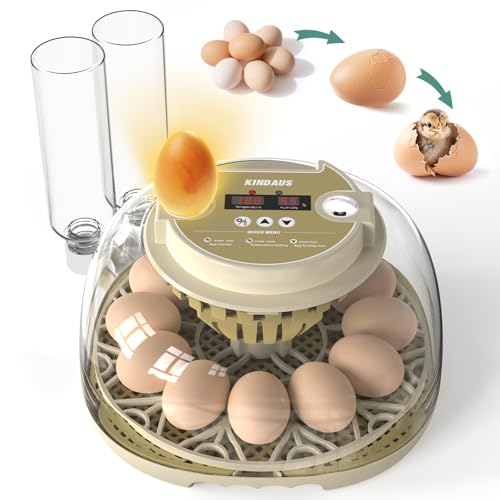
The KINDAUS incubator highlights an easy-to-read LED display for temperature and humidity, enabling accurate environmental monitoring. Automatic egg turning supports even embryo development, while a 360° viewing lid and built-in egg candler allow continuous observation and early detection of non-viable eggs. This model strains toward straightforward operation with robust visibility.
Buying Guide
Choosing the right incubator involves balancing capacity, control features, ease of use, and reliability. Consider these purchase aspects to align a model with your hatching goals:
- Capacity and space: Start with your target egg count per hatch and available workspace. If you plan to hatch several times, a larger unit with adjustable trays provides flexibility.
- Temperature and humidity control: Look for stable temperature via a reliable fan or convection system and humidity management through external refilling or adjustable vents. Digital displays help monitor conditions in real time.
- Egg turning: Automatic turning reduces manual handling and improves hatch consistency. Check the turning interval and mechanism to ensure it suits the egg types you’re incubating.
- Visibility: A clear lid or window, ideally with a built-in candler, helps track embryo development without disturbing the incubation environment.
- Water management: External water refill features minimize temperature swings, preventing interior humidity from dropping suddenly when adding water.
- Species adaptability: If you plan to incubate different species (chickens, ducks, quail, pheasants), verify that the unit supports varied egg sizes and recommended humidity levels.
- Build quality and warranty: Durable plastics, solid hinges, and responsive customer support can matter for ongoing use in classrooms or farms.
When comparing models, prioritize systems that maintain stable conditions with minimal lid openings, offer clear monitoring interfaces, and provide practical features like built-in candling and external water refill. For educators and hobbyists alike, a balance of capacity, ease of use, and reliable environmental control is key to achieving higher hatch success rates.