Choosing the right toys supports early cognitive, motor, and sensory development. This guide highlights five development-focused toys designed to engage little learners, build fine motor skills, and spark curiosity across ages from six months to preschool. Each pick features hands-on play, safe materials, and engaging textures or sounds to encourage exploration and growth.
| Product | Brand | Key Benefit | Amazon Link |
|---|---|---|---|
| Sassy Stacks of Circles Stacking Ring | Sassy | Fine motor growth and hand-eye coordination | View |
| MINGKIDS Montessori Toys | MINGKIDS | Multi-sensory shape recognition and problem solving | View |
| Airbition Talking Flash Cards | Airbition | Vocabulary growth and speech development | View |
| LiKee Open Ended Wooden Shape Puzzles | LiKee | Spatial awareness and problem solving | View |
| PEBIRA Montessori Sorting & Stacking Toys | PEBIRA | Color and shape recognition with hands-on sorting | View |
The table above introduces five development-focused toys chosen for a range of ages and learning goals. Each product emphasizes interactive play that encourages fine motor skills, sensory exploration, vocabulary, spatial reasoning, and early problem-solving. Below, discover detailed sections for each item, with practical usage notes and distinct features that support development milestones.
Sassy Stacks Of Circles Stacking Ring

The Sassy Stacks of Circles is a 9-piece set designed to strengthen hand-eye coordination and fine motor skills as babies manipulate rings of varying textures and weights. The straight post accepts differently sized rings, encouraging experimentation with size and balance. Textural variety provides safe mouth exploration while supporting early tactile development. The chunky rings are easy for small hands to grasp, promoting independence during playtime and repeated grasp-and-stack activities that help form basic problem-solving habits.
MINGKIDS Montessori Toys For 1 Year Old

This 6-piece set offers multi-sensory shape play that prompts toddlers to push shapes through elastic bands, fostering curiosity, exploration, and discovery. Made with child-friendly ABS plastic, the toy features rounded corners and smooth edges for safe handling. Each of the six chunky shapes includes distinct textures to stimulate tactile perception and promote color and shape recognition. As children manipulate the pieces, they build hand-eye coordination and strengthen fine motor skills while learning about textures, colors, and patterns.
Airbition Talking Flash Cards
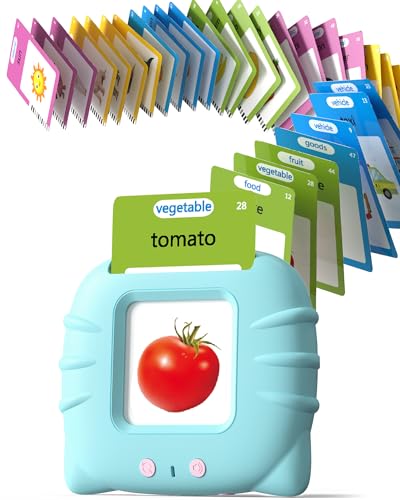
The Airbition Talking Flash Cards combine 224 colorful illustrations with audible content to expand vocabulary and support cognitive development. The device provides a standard American voice with animal sounds and a repeat function, making it a practical tool for speech development and early language practice. With five volume levels, the toy accommodates growing listening skills while enabling parents or therapists to tailor sessions. This toy is well-suited for Montessori-inspired language play and memory reinforcement through audio-visual association.
LiKee Open Ended Wooden Shape Puzzles

LiKee’s wooden shape puzzles feature 36 shape blocks and 60 pattern cards, plus sturdy storage tins. Children can replicate on-card designs or innovate new creations, promoting spatial reasoning, sorting, and problem-solving. The puzzles help with color and shape recognition while building fine motor control as little hands pick up, rotate, and fit blocks. The open-ended design encourages creative thinking and safe, imaginative play away from screens.
PEBIRA Montessori Sorting & Stacking Toys

PEBIRA’s wooden sorting and stacking toy set emphasizes colors, shapes, and numbers through 20 pieces across five colors and five geometric shapes. Kids match blocks to colors or holes on pegs and tackle arrangement challenges, which develops early geometry, color differentiation, and number sense. The design is travel-friendly with smooth edges and durable construction, making it suitable for toddlers and preschoolers to practice spatial reasoning and hand-eye coordination in a self-directed learning context.
Buying Guide
- Age appropriateness: Choose toys labeled for the child’s current age and skill level to prevent frustration or safety concerns. Look for simple-to-complex progression in activities to support ongoing development.
- Motor and cognitive goals: Consider whether the toy prioritizes fine motor skills, problem solving, language, or sensory integration. Multi-sensory toys can support multiple milestones at once.
- Materials and safety: Prioritize non-toxic materials, rounded edges, and durability. For younger children, avoid articles with small parts that could pose choking hazards.
- Stimulus balance: Effective development toys provide a balance of textures, colors, sounds, and shapes to maintain engagement without overstimulation.
- Portability and storage: For travel or small spaces, select compact, easy-to-store solutions that still offer meaningful play opportunities.
- Learning style compatibility: Some children learn best through hands-on manipulation, while others benefit from sound-based or tactile cues. A mix of formats can address diverse learning preferences.
- Skill development scope: Consider whether you want a toy that supports color and shape recognition, spatial reasoning, or language development primarily, or a combination that covers multiple domains.
These five picks provide a balanced set of options for parents seeking development-focused toys that support motor, sensory, and cognitive growth. When selecting, align the toy’s features with the child’s current developmental stage and curiosity to maximize learning through play.