Whether you’re starting your celestial journey or upgrading a beginner setup, choosing the right telescope matters. This guide highlights five accessible, beginner-friendly options that help new stargazers explore the night sky with clarity and ease. Each model offers reliable optics, easy assembly, and handy accessories like phone adapters for quick astrophotography. Use the quick-reference table below to compare core specs at a glance before diving into detailed product sections.
| Product | Brand | Main Advantage |
|---|---|---|
| Telescope 80mm Aperture 600mm | HEXEUM | Versatile 80mm aperture with multi-coated optics and wireless control |
| Gskyer Telescope, 70mm Aperture | Gskyer | Compact entry-level refractor with remote and phone adapter |
| GALAEYES 80mm Aperture 600mm | GALAEYES | Bright optics with terrestrial and celestial versatility |
| Celestron StarSense Explorer LT 114AZ | Celestron | Smartphone-guided sky survey for quick target finding |
| Celestron PowerSeeker 127EQ | Celestron | Manual German equatorial mount for precise tracking |
HEXEUM 80mm Refractor With AZ Mount
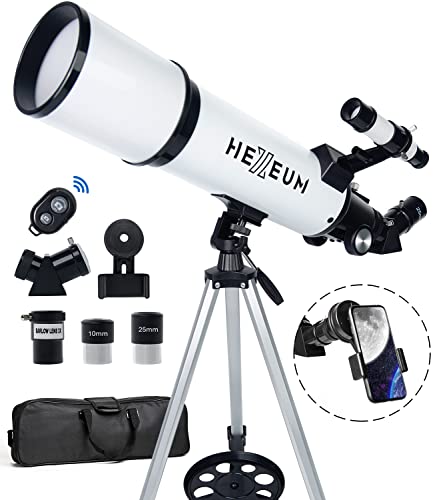
The HEXEUM telescope is an 80mm aperture refractor with a 600mm focal length, designed for beginners and families. It includes two eyepieces (25mm and 10mm) for 24x and 60x magnification, plus a 3x Barlow lens to boost power. A 5×24 finder helps locate objects, while a multi-coated optical path enhances brightness and clarity. The setup is portable thanks to an adjustable aluminum tripod and a dedicated phone adapter. A wireless remote control and carrying bag support easy field use, photo capture, and sharing celestial moments.
Gskyer 70mm Aperture Refractor

Gskyer offers a 70mm aperture refractor with a 400mm focal length for compact portability and sharp image quality. The system ships with two replaceable eyepieces plus a 3x Barlow lens, boosting magnification. A 5×24 finder scope with crosshair lines speeds object location, while a phone adapter and wireless remote facilitate easy astrophotography. This setup is well-suited for beginners who want a travel-ready instrument capable of both lunar and planetary views as well as daytime terrestrial observations.
GALAEYES 80mm Aperture 600mm F.L. Refractor

The GALAEYES telescope features an 80mm aperture and 600mm focal length with fully coated optics, delivering brighter, clearer views. Its erect-image prism supports terrestrial viewing in addition to celestial observing, making it versatile for spotting planets, moons, and distant landscapes. An intuitive finder and smartphone adapter simplify setup, while the included carrying bag and portable design support on-the-go astronomy for beginners and casual observers alike.
Celestron StarSense Explorer LT 114AZ
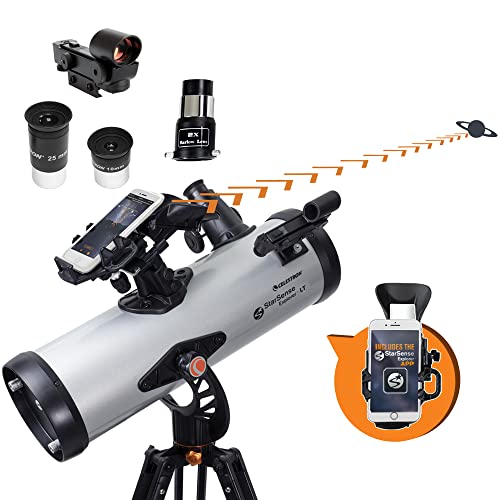
The StarSense Explorer LT uses patented StarSense technology to analyze sky patterns and guide the telescope to celestial targets. Simply dock a phone, run the StarSense app, and follow on-screen directions to locate planets, nebulae, and star clusters. It provides a curated list of targets based on time and location, enhancing the learning experience for beginners who want a technologically assisted observing session without heavy setup.
Celestron PowerSeeker 127EQ

The PowerSeeker 127EQ is a classic entry-level Newtonian reflector on a manual German Equatorial mount. It offers ample light gathering for planets, the Moon, and brighter deep-sky objects, with smooth tracking that helps beginners learn celestial navigation. Its compact, portable design makes it suitable for backyard use or camping trips, and the included manual controls support hands-on learning of telescope alignment and sky surveying.
Buying Guide: Key Purchase Considerations For Amateur Astronomers
- Aperture and light-gathering ability: Larger apertures reveal fainter objects and finer details, but they increase weight and cost. Balance aperture with portability for beginners.
- Focal length and magnification: Longer focal lengths yield higher magnification with appropriate eyepieces, yet a very high magnification is not useful without bright, steady optics and stable mounts.
- Optics quality and coatings: Fully coated optics improve brightness and contrast. Look for multi-coated lenses and good glass quality to reduce glare and color distortion.
- Mount type and tracking: Equatorial mounts are great for learning sky navigation and tracking objects, while alt-az mounts are simpler and intuitive for beginners.
- Ease of setup and included accessories: Packages with smartphone adapters, remote controls, finderscopes, and carrying bags reduce barriers to starting observations.
- Portability and storage: Lightweight, compact models are ideal for travel and quick sessions, whereas larger scopes may stay mostly at one observing site.
- Software and apps: Apps that assist with star mapping or object targeting (like StarSense) can accelerate learning for new users and help plan sessions.
- Future-proofing: Consider upgrade paths, such as adding more eyepieces, a better mount, or a computerized system later on, to extend the telescope’s life as skills grow.