Explore the solar system with hands-on, spinning models that visualize planetary motion, rotations, and orbits. This guide highlights top educational kits that mix building with interactive motion, perfect for classroom or home science projects. Each kit emphasizes STEM learning, safe assembly, and engaging demonstrations of orbital dynamics.
| Product | Brand | Pieces | Key Feature |
|---|---|---|---|
| DOLIVE Dual-Mode Spinning Solar System | DOLIVE | 1282 PCS | Motorized rotation with manual hand crank |
| Spinning Solar System Space Building Kit | WEMEWEME | 964 PCS | Rotatable planets with gear-driven orbital motion |
| Science Can Solar System for Kids | Science Can | — | Talking solar system with projector and quiz mode |
| DaTengPin Spinning Solar System Blocks | DaTengPin | 946 PCS | 9 planets with rockets and satellites, multi-gear design |
| CAEROKEERL Solar System Space Toys | CAEROKEERL | 775 PCS | 9 planets with rotating control and STEM focus |
DOLIVE Dual-Mode Spinning Solar System Kit
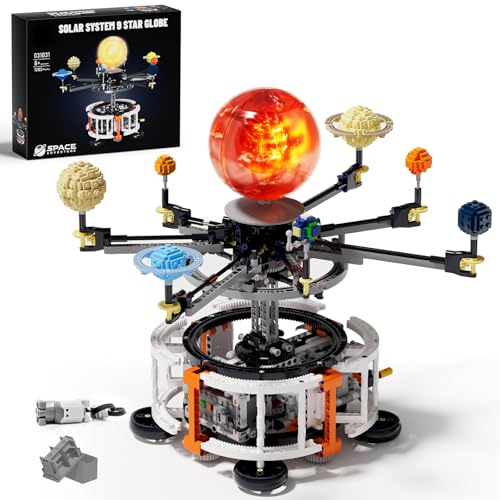
The DOLIVE kit enables a scaled solar system with 8 planets and the Sun, designed to demonstrate planet sizes, colors, and orbital relationships. It features a built-in motor for automatic rotation and a manual hand crank for self-rotation, helping learners visualize orbital paths. Clear assembly instructions aim to support safe, straightforward construction, with pieces that securely fit to enhance the building experience.
Spinning Solar System Space Building Kit by WEMEWEME

This kit uses a rotatable solar system with a gear-connected motion that simulates planetary orbits. It emphasizes interactive learning by letting kids rotate planets around the sun, while exploring planet characteristics and the mechanics of orbital motion. The design supports STEM exploration and compatibility with multiple space-themed components to boost creative building and discovery.
Science Can Solar System for Kids with Projector

The Science Can kit combines a talking solar system with a planetary projector that displays 24 full-color space images via disks. It supports language options in English and French and includes interactive quizzes to reinforce astronomy concepts. This kit provides a classroom-friendly learning experience with engaging visual projections of planets, moons, and space phenomena.
DaTengPin Spinning Solar System Blocks

DaTengPin offers a 946-piece solar system kit with rotating Earth, Moon, and Sun plus rockets and satellites. By turning a handle, children observe orbital motion and build an immersive display of the solar system. The kit emphasizes hands-on learning, basic gear mechanics, and compatibility with standard building blocks for expanded creativity and family-building opportunities.
CAEROKEERL Solar System Space Toys

CAEROKEERL’s kit focuses on nine rotating planets with a central sun, emphasizing imaginative exploration and STEM learning. It is designed to inspire curiosity about astronomy while providing a hands-on build that demonstrates planetary motion and the relationships among celestial bodies. The set underlines educational value through structured building and guided play.
Buying Guide: Key Purchase Considerations
- Learning goals: Choose a kit that matches the learner’s age and desired depth—entry-level builds emphasize motion visualization, while advanced sets include gears, motors, and projectors for deeper mechanics.
- Motion type: Consider whether you want manual rotation, motorized rotation, windup mechanisms, or a projector-based experience. Motorized and windup options offer continuous demonstrations of orbital paths without manual effort.
- Pieces and compatibility: Higher-piece counts enable more detailed models but require more time to assemble. Check if parts are compatible with common building blocks to allow expansions.
- Engagement features: Light, sound, or interactive quizzes can enhance retention and interest, especially for younger learners or classroom use.
- Storage and durability: Look for sturdy construction and clear bag or tray organization to support ongoing use and easy cleanup after experiments.
- Safety and age range: Verify that pieces are large enough to minimize choking hazards for younger children and that the kit complies with safety standards for home use.
- Educational value: Some kits include additional learning materials (fact cards, disks with images, or multilingual options) that extend science literacy beyond the model.
Quick Comparison of Core Features
- Motion: Manual crank, motorized rotation, windup, or projector-based visuals
- Planets included: 8–9 planets plus the Sun, with some kits adding moons, rockets, or satellites
- Learning aids: Step-by-step assembly, fact cards, disks with images, or interactive quizzes
- Expansion potential: Many kits are compatible with standard bricks and can be augmented with extra components
- Target age: Ranges typically from ages 6–14+, with some options for teens and adults as decorative displays