Roller coaster building kits offer engaging ways to explore physics, engineering, and problem solving at home or in the classroom. The following five products provide hands-on projects that teach force, motion, energy, velocity, and design challenges while delivering satisfying, working models. Each option covers a range of ages and skill levels, from beginner to advanced builders, and includes clear instructions, diverse track layouts, and opportunities for experimentation.
| Product | Brand | Key Benefit |
|---|---|---|
| Thames & Kosmos Roller Coaster Engineering STEM Kit | Thames & Kosmos | Working coaster models with physics experiments |
| K’NEX Education – Roller Coaster Set | K’NEX | Large parts set with motor and multiple models |
| ThinkFun Roller Coaster Challenge | ThinkFun | 50% logic game, 50% building set |
| K’NEX 51438 Typhoon Frenzy Roller Coaster | Basic Fun | Two build options, over 640 pieces |
| Wood Trick Wooden Marble Run Electric Motorized | Wood Trick | Wood-based, motorized, large-scale model |
Thames & Kosmos Roller Coaster Engineering STEM Kit

The Thames & Kosmos kit invites builders to design and test their own working roller coaster models. It emphasizes hands-on physics experiments to explore force, motion, energy, and velocity, while presenting challenges that require constructing coasters of various shapes and sizes. The kit supports inquiry-based learning and provides a solid foundation for exploring core STEM concepts through practical applications.
K’NEX Education: Roller Coaster Set – 546 Pieces

Featuring 546 pieces and a motor, this set supports collaborative or individual building for both basic and advanced learners. It includes two additional models (a ramp and a half-pipe) and an activity guide aligned with STEM standards for grades 5–9. Builders can explore relationships between time, distance, speed, and more as they iterate designs.
ThinkFun Roller Coaster Challenge

ThinkFun’s Roller Coaster Challenge blends logic puzzles with engineering. The set includes a game board, tracks, posts, a coaster car, and 40 challenge cards with solutions. It’s designed to develop engineering thinking, reasoning, and planning skills in a compact, play-centered format suitable for ages 6 and up.
K’NEX 51438 Typhoon Frenzy Roller Coaster
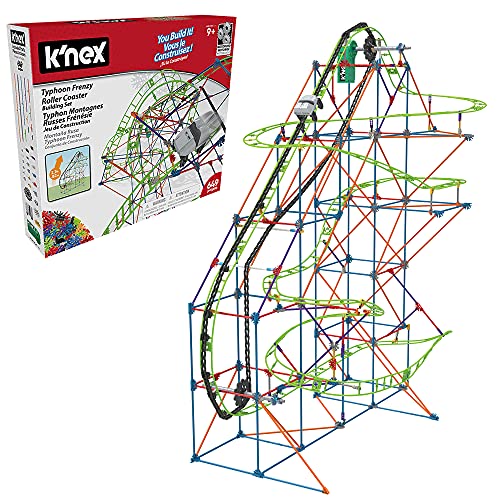
This set builds a 19-foot-long roller coaster with more than 640 pieces and a motorized power system. It offers two models to build, expanding playtime and learning opportunities. The construction process supports fine motor skills, logical thinking, and problem-solving as builders plan and adjust track layouts.
Wood Trick Wooden Marble Run Electric Motorized
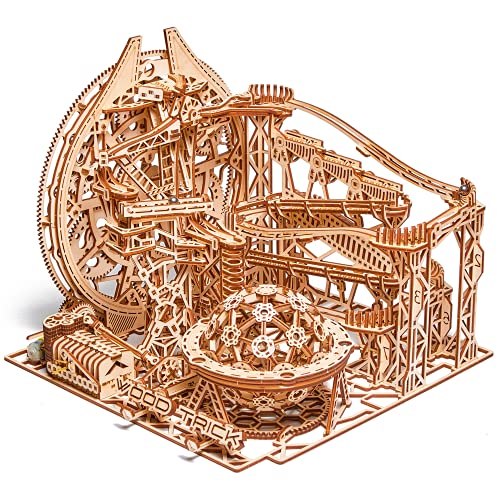
Wood Trick’s large wooden model uses an electric motor to power a marble-run roller coaster. The kit emphasizes natural wood components, precision cutting, and an engaging, motorized design. It’s a substantial build that demonstrates energy transfer and kinetic motion with a tactile, durable finish.
Buying Guide
- Age and skill level: Choose sets with appropriate complexity and clear assembly instructions for the builder’s experience.
- Learning outcomes: Look for kits that explicitly connect to physics concepts like force, energy, velocity, and momentum.
- Motorization and power: Motorized tracks offer dynamic demonstrations, but non-motorized options can encourage manual problem-solving and iteration.
- Build complexity and expandability: Some sets include multiple models or expansion possibilities, enabling ongoing learning as skills grow.
- Durability and materials: Wood-based kits tend to be robust and visually appealing, while plastic sets can be lighter and more modular.
- Educational alignment: If used in classrooms, prefer kits with accompanying guides, activities, or standards alignment.
- Maintenance and parts availability: Check whether replacement parts or additional pieces are easy to source if a piece is lost or damaged.
- Storage and space: Consider the footprint of larger sets—table space and shelf storage can influence which kit is practical.
In selecting a roller coaster model kit, users should balance complexity, educational value, and playtime to match the builder’s goals. The five options above cover a spectrum from compact, logic-based challenges to large, motorized builds with comprehensive instruction sets. Each offers a tangible way to explore physics and engineering while building confidence in problem solving and design iteration.