Exploring rocketry can be an exciting mix of science, engineering, and outdoor play. This guide highlights five ready-to-fly or beginner-friendly rocket kits and launcher options that suit a range of ages and skill levels. Each product below is selected for ease of use, educational value, and reliable performance, helping aspiring rocketeers launch confidently on clear, open spaces.
| Product | Brand | Altitude | Recommended Ages | Notes |
|---|---|---|---|---|
| Estes Mav Flying Model Rocket Kit 7283 | Estes | Up to 250 ft | 10+ | Beginner-friendly Destination Mars design |
| Estes 7244 Flying Model Rocket Kit Indicator | Estes | Up to 1100 ft | 10+ | Quick launch setup with preassembled parts |
| Eieymct Rocket Launcher for Kids | Eieymct | Up to 200 ft | 8-13 | Motorized, two height settings, reusable parachute |
| National Geographic Air Rocket Toy | Blue Marble | Up to 100 ft | 8-12 | Glow-in-the-dark option adds night-play fun |
| Estes 0653 Ripley Rocket-Building Kit | Estes | Up to 600 ft | 13+ | Intermediate kit with detailed build |
These selections provide a spectrum of experiences, from quick-launch intructions suitable for younger builders to more involved builds that challenge older enthusiasts. Each entry lists the core features to help families compare options and plan safe, engaging launches.
Estes Mav Flying Model Rocket Kit
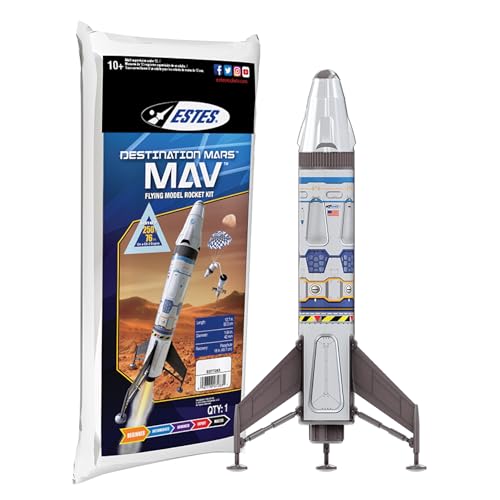
The MAV rocket-building kit introduces beginners ages 10 and up to aerospace science with a hands-on, ready-to-build experience. It includes a body tube, molded fins, a nose cone, self-stick decals, and a recovery parachute. The kit is designed for simple assembly and works with standard Estes engines, a launch pad, starters, and recovery wadding (sold separately). It stands about 12.7 inches tall and is optimized for stable flights up to about 250 feet when paired with an appropriate engine. This model fuels curiosity about Mars exploration, serving as a practical STEM activity for classrooms, families, or clubs.
Key features: beginner-friendly build, Mars-inspired design, compatibility with common launch accessories, and a compact altitude range suitable for small launch sites. For best results, use with the Estes Porta Pad II Launch Pad and an electron beam controller (sold separately) to streamline the lift-off experience.
Estes 7244 Flying Model Rocket Kit Indicator

The Sundance/Indicator model emphasizes quick setup with a strong, high-quality Estes body tube, an easily assembled nose cone, and a colorful preassembled parachute. This ready-to-launch option can reach impressive heights of up to 1100 feet when used with the appropriate engines. It is suitable for ages 10 and up, with adult supervision for younger builders. The kit requires some assembly, reflecting a slight step up in complexity while still targeting accessible outcomes for new rocketeers.
Highlights include fast prep time and a design that supports confident, higher-altitude flights, making it a reliable stepping-stone to more advanced kits for those who enjoy longer flights and a more intricate build process.
Eieymct Rocket Launcher For Kids

This self-launching launcher adds a motorized dimension to outdoor rocket play. It offers two height settings, delivering up to 100 feet on a single press or about 200 feet with two presses. Built with a durable EPP foam fuselage, it ensures smooth flights and safe landings. The parachute deploys automatically at peak altitude, allowing quick reuse. Suitable for kids ages 8 to 13, it supports engaging, repeated launches in larger backyards or parks and helps teach basic propulsion concepts and timing through direct play.
Considerations include battery availability, compatibility with standard rockets, and the need for an open outdoor area for safe operation. It serves as an approachable option for families seeking reliable, repeatable launches without a full-scale rocket kit.
National Geographic Air Rocket Toy

Blue Marble’s National Geographic Air Rocket Toy provides a duo of engaging features: a dual launcher for competitive play or collaborative launches and glow-in-the-dark rockets for night-time excitement. The kit includes two foot pumps, a dual launch pad, and four foam rockets, enabling quick setup and easy sharing among friends or family. The adjustable launch tube allows experimentation with angles and trajectories, reinforcing basic aerodynamics concepts while promoting active outdoor play.
Best for kids who enjoy hands-on science games, this option blends physical activity with STEM learning, offering a practical way to explore projectile motion, timing, and coordination.
Estes Ripley Rocket-Building Kit

The Ripley kit targets older or more experienced builders seeking a more involved project. At 13 inches tall, the Ripley features a bold, alien-inspired design and supports flight up to about 600 feet using common Estes engines. The build requires approximately two hours and includes precision parts, a detailed nose cone, decals, and step-by-step instructions. This intermediate kit is well-suited for classrooms, clubs, or family projects where learners want to deepen their rocketry skills and practice meticulous assembly ahead of launches using a launch pad and controller (sold separately).
Key considerations include time for assembly, the selection of compatible engines, and the desire for a more challenging, visually striking rocket. It can serve as a focal point for discussions about materials, aerodynamics, and flight stability.
Buying Guide: Key Purchasing Considerations And Comparisons
When choosing a rocket kit or launcher, consider:
- Age and Skill Level: Start with beginner kits for ages 8-12, then move to intermediate or advanced kits as confidence and understanding grow. Parental supervision is important for younger builders.
- Altitude Target: If you’re launching in small spaces, select models designed for lower altitudes (e.g., 100–250 ft). For larger yards or fields, higher-altitude options (up to 1100 ft or more) may be desirable.
- Assembly Time: Some kits are “ready to assemble” while others require more time. Plan for build sessions and drying times to avoid rushed results.
- Launch Accessories: Ensure you have a compatible launch pad, starters, and recovery wadding. Some kits include these, others do not. Safety gear and adult supervision are essential.
- Engine Compatibility: Most Estes models use standard engines. Check compatibility with engine size and number of engines allowed by your launcher and local regulations.
- Safety And Space: Always choose outdoor spaces away from people, vehicles, buildings, and trees. Follow local regulations and remove obstructions before a launch.
- Reusability And Storage: Reusable parachutes and recovery wadding help contain costs and waste. Consider kits that are easy to store and transport for multiple launches.
- Learning Value: For classrooms or home education, pick kits that promote STEM learning with explicit references to flight principles, stability, and propulsion concepts.
In practice, beginners often prefer a kit with straightforward assembly and a modest flight ceiling, paired with a dependable launcher. Intermediate to advanced builders typically favor kits with more detailed parts, higher altitude potential, and expansion options, such as additional engines, larger launch pads, or advanced controllers.