For hobbyists building or upgrading RC crawlers, a high-torque steering servo is essential to conquer tough terrain. This article highlights five durable, high-torque servos suited for 1/8, 1/10, and 1/12 scale crawlers, buggies, and robots. Each option offers strong gears, waterproofing, and precise control to improve steering responsiveness and reliability. Read on to compare features, compatibility, and performance considerations that matter most for crawler setups.
| Product | Brand | Torque | Voltage | Notes |
|---|---|---|---|---|
| ANNIMOS 45KG | ANNIMOS | 45 kg·cm | 8.4V | Full metal gear, 270°, waterproof |
| INJORA 35KG | INJORA | 35 kg·cm | 6V | Digital, stable, low noise |
| HOOYIJ 40KG DS3240MG | HOOYIJ | 40 kg·cm | 4.8–6.8V | Full metal gears, 180° |
| Miuzei 25KG | Miuzei | 25 kg·cm | 8.4V | 270°, waterproof |
| GOUPRC 70KG | GOUP RC | 70 kg·cm | 8.4V | All-steel gears, 180° |
When selecting a steering servo for crawling, consider torque, gearing, waterproofing, control angle, and voltage compatibility. Higher torque improves steering under load from traction and steering lock, while robust gearing reduces wear on rough terrain. Waterproofing protects electronics from mud, water, and splashes common in off-road environments. Voltage compatibility affects speed and stall torque, and the control angle determines how sharply the servo can turn the wheels. The following five products are representative options across a range of torque levels and configurations.
ANNIMOS 45KG High Torque Servo

The ANNIMOS DS3245SG offers 45 kg·cm of torque, suitable for heavy-duty RC crawlers and robotics projects. It uses full metal gears and a high-precision digital chip to deliver reliable performance. A CNC aluminum middle shell contributes to stability and heat dissipation. The servo is designed for demanding off-road use, including 1/8 and 1/10 scale builds, where consistent steering under load is critical. Control speed and torque at 8.4V, with a claimed speed of 0.11 seconds per 60° at full voltage. Waterproof seals add resilience in muddy conditions.
INJORA RC Servo 35KG Digital

INJORA’s 35KG digital servo emphasizes precision and stable torque for mid-range crawlers. Built with reinforced metal gears and a low-noise digital chip, this servo provides reliable control with a smooth response suitable for 1/10 scale builds. While its torque is lower than the heavier options, it remains a solid choice for lighter crawlers or campers where speed and precision are prioritized over maximum torque. Compatibility with standard RC control boards makes it accessible for beginners upgrading from hobby-grade servos.
HOOYIJ 2 Pack 40KG DS3240MG

HOOYIJ offers a 40KG digital servo with DS3240MG full metal stainless steel gears and 180° control. The waterproof design with rubber seals and a CNC aluminum middle shell emphasizes durability for rugged crawling. It operates on a broad 4.8–6.8V range and provides strong stall torque at higher voltages, making it well-suited for heavy crawlers and aggressive steering requirements. The two-pack option can simplify fleet upgrades or dual steering setups for larger models.
Miuzei 25KG High Torque Waterproof Servo

Miuzei presents a compact 25KG servo with full metal gears and 270° rotation, designed for reliable steering in lighter crawlers and other RC platforms. Built-in anti-burning and rotor-block protection provide added safety for hobbyists who push their setups with longer sessions or extended use. Its waterproof construction suits wet courses, though its torque is modest compared to top-tier models. The 8.4V operation supports faster response in compatible power systems, while the 25T horn is a common fit for many standard builds.
GOUPRC 70KG Brushless Servo
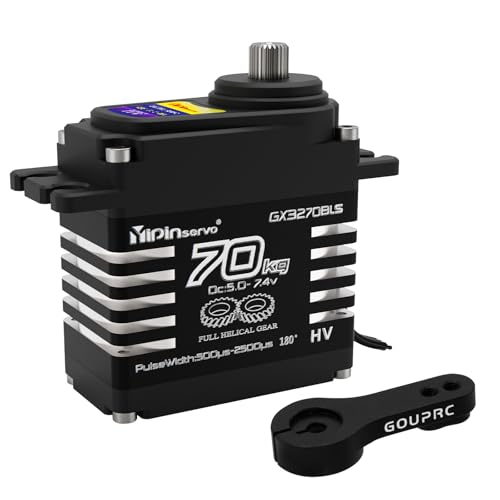
The GOUPRC 70KG servo is built for extreme crawling demands, using all-steel gears, 6BB ball bearings, and a brushless motor for high efficiency and endurance. With an 8.4V supply, it achieves up to 70 kg·cm of torque and fast response at 0.08 seconds per 60°. The 180° control angle provides broad steering options, and the magnetic encoder angle sensor supports accurate position feedback. This option suits large or heavily loaded crawlers that require decisive, robust steering under load.
Buying Guide: Key Considerations And Comparisons
Torque versus speed: Higher torque improves steering under load, but may reduce speed. For aggressive crawlers, prioritize torque around 40–70 kg·cm, with a responsive 0.08–0.2 sec/60° speed range at the operating voltage.
Gearing and materials: Full metal gears, stainless steel components, and CNC aluminum housings increase durability, heat dissipation, and lifespan in rough terrain.
Waterproofing and seals: IP-rated designs protect electronics from mud, water, and dust. For wet courses, look for waterproof seals and corrosion-resistant hardware.
Voltage compatibility: 6V systems are common in smaller builds, while 7.4–8.4V systems provide higher torque and speed. Confirm compatibility with your ESC and receiver.
Control angle: Most crawlers perform well with 180° steering, though some setups may benefit from extended travel (270°) for unusual steering geometry.
Durability and service life: Consider servo housing reinforcement, gear material, and the availability of replacement parts or upgrades. Two-pack options can be helpful for dual-servo steering or spare parts.
Integration: Check horn compatibility (like 25T) and mounting pattern to ensure a smooth installation with your existing chassis and linkages.
Price-to-performance: While top-end models deliver peak torque, mid-range servos often provide the best balance for most crawlers without overkill on weight or power draw.
Usage scenarios: For tight, rocky tracks, prioritize high torque and reliable waterproofing. For lighter racers or touring crawlers, mid-range torque with good control accuracy can be sufficient.
In summary, the best RC crawler steering servo depends on your model size, terrain, and control expectations. The five options above cover a spectrum from compact, cost-effective 25–35 kg·cm units to heavy-hitting 70 kg·cm systems. When choosing, align torque and voltage with your motor and ESC, ensure waterproofing meets your environment, and verify mounting compatibility with your chassis. This approach helps ensure reliable steering performance across diverse crawling challenges.