Discover a curated set of piano learning program tools designed to support beginners and enthusiasts. From learning aids and method books to note-labels and interactive guides, this guide highlights practical items that can improve familiarity with keys, reading music, and daily practice. The following selections emphasize clarity, durability, and ease of use for American students of all ages.
| Product | Brand | Type | Key Benefit |
|---|---|---|---|
| Piano Keyboard Stickers for 88/61/54/49/37 Key | COYAHO | Label Stickers | Colorful letters on removable stickers for quick key recognition |
| Adult Piano Adventures: All in One Course | Faber Piano Adventures | Method Book | Comprehensive beginner course with chords and notation |
| BEATBIT Piano Notes Guide | BEATBIT | Note Strips | Silicone note strips for quick reference without residue |
| Piano Adventures: Lesson Book Primer Level | Faber Piano Adventures | Lesson Book | Foundation songs and technique for early learners |
| First 50 Popular Songs You Should Play on Piano | Hal Leonard | Songbook | Accessible repertoire to build confidence |
Piano Keyboard Stickers for Beginners
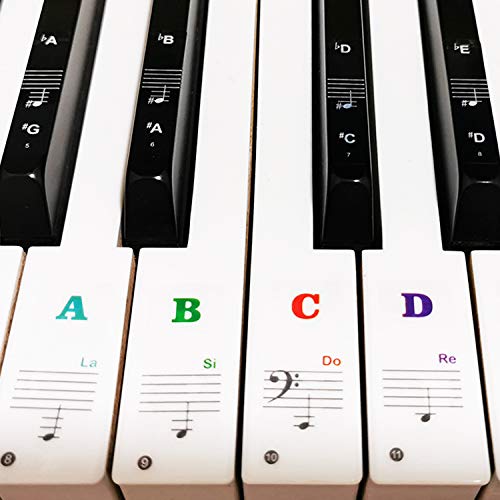
The COYAHO Piano Keyboard Stickers are designed for learners at multiple keyboard sizes, enabling quick visual association with notes. Each sticker measures 4.0 cm by 1.55 cm for white keys and 3.9 cm by 0.85 cm for black keys. The letters appear on the backside of a transparent layer, ensuring durability and legibility even with frequent touch. The stickers are waterproof and wipe clean, making maintenance simple for practice spaces.
Key advantages include a residue-free application and removal, allowing repeated use without harming the keyboard surface. This makes them suitable for classrooms, home studios, and travel practice setups where quick labeling supports reading and memory skills.
Adult Piano Adventures: All in One Course

This Faber Piano Adventures book serves as a comprehensive beginner method for adults, integrating chords with standard notation. It emphasizes accessible concepts and practical progression, presenting more than 90 songs to illustrate theory and technique. The material is arranged for self-guided learning, supporting steady improvement in reading, rhythm, and finger coordination.
BEATBIT Piano Notes Guide

The BEATBIT Note Strips provide a no-sticker alternative for learners who prefer a tidy keyboard. Made from silicone, the strips connect in series and do not adhere to keys, allowing easy removal without leaving residue. The double-staff presentation helps learners quickly locate notes in treble and bass staves, aligning with common piano scores and accelerating early sight-reading practice.
Piano Adventures: Lesson Book Primer Level

This primer-level lesson book from Faber Piano Adventures introduces foundational concepts, including early songs that teach dynamics and pedal use. It is designed for young learners and adults alike, providing structured practice in a format that blends musical literacy with performance readiness. The collection reinforces essential five-finger patterns and rhythmic understanding through approachable repertoire.
First 50 Popular Songs You Should Play on Piano

This Hal Leonard songbook offers a curated set of 50 popular tunes across pop, jazz, and Broadway to build confidence and engagement. With beginner-friendly arrangements, learners can practice melodies they recognize while gradually expanding their technique, reading, and timing. The pages provide accessible entry points to performance-ready sections that teachers and students can enjoy together.
Piano Adventures: Lesson Book Level 2A

The Lesson Book Level 2A from Faber continues the beginner journey with emphasis on eighth notes, chords, and sight-reading. It is designed for early learners who have progressed from primer materials and are ready to expand technical vocabulary and rhythmic understanding. The book blends engaging musical selections with practice routines to support consistent growth.
Buying Guide: Key Considerations for a Piano Learning Program
- Learning goals: Assess whether the focus is on reading notation, finger technique, or practical play-along songs, and choose materials that align with those goals.
- Learning style: Consider whether a visual labeling system (stickers or note strips) suits the student, or if a theory-based approach with method books is preferable.
- Durability and setup: For younger learners or frequent travelers, durable tools and residue-free solutions reduce setup friction and classroom wear.
- Progression: A structured sequence that gradually increases complexity helps sustain motivation and tracks improvement over time.
- Supplemental tools: Combining note-labels, method books, and curated songbooks can cover technique, theory, and repertoire for well-rounded growth.
- Accessibility: Ensure materials are easy to acquire, with clear print and readable notation for beginners and parents or teachers guiding practice.
- Practice integration: Tools should integrate with daily routines, enabling quick warm-ups, on-the-go practice, and classroom use without heavy setup.