Phonics flash cards are a practical, hands-on way to boost early reading skills. This article highlights five top-rated sets designed for kids ages 4–8, covering foundational phonics, sight words, word families, and engaging activities. The selections combine teacher-designed approaches with interactive features like rings, flip books, and colorful illustrations to keep learners motivated. Read on to see how these kits compare and which might fit your classroom or homeschool needs.
Summary of Selected Products:
- The Bambino Tree Phonics Flash Cards — 62 flashcards, four sorting rings, 120 sentences, four difficulty levels.
- Scholastic Flash Cards: Sight Words — focused sight word practice with English language arts emphasis.
- School Zone Phonics Made Easy Flash Cards — 54 full-color flash cards plus online access and parent reference.
- Phonics Flash Cards by underbartliv — 62-card set with four levels and 20 phonogram families.
- Phonics Flash Cards Word Family Build Book by Edulok — 30 word-family flip books for interactive word-building.
THE BAMBINO TREE Phonics Flash Cards

Designed for a structured progression, this set offers 62 flashcards across four phonogram family groups and four difficulty levels. It includes four sorting rings, 480 words and pictures, and 120 sentences to build fluency. The kit is teacher-endorsed and targets Level 1 through Level 4 concepts—from CVC word blending to digraphs, long vowels, and more complex phonics. Its interactive visuals and game-friendly design help maintain engagement while building essential decoding skills.
Key features include a focus on blending fundamentals, teacher-recommended structure, and a user-friendly format that supports independent practice or guided lessons. With clear tiered activities, children can experience incremental mastery, helping reading readiness while keeping sessions lively and interactive.
Scholastic Flash Cards: Sight Words

This set focuses on sight word recognition within a language arts framework. It can support foundational reading by helping learners quickly recognize high-frequency words, a critical step in fluent reading. The bundle is suitable for early readers and aligns with classroom practice aimed at increasing sight word fluency and text comprehension. While concise, it offers practical, straightforward flash cards that complement broader phonics study with a strong emphasis on word recognition.
Educators can integrate these cards into daily warm-ups or quick review activities. The simple, English-language basis makes them accessible for homeschoolers and classroom use alike, with a clear focus on building automatic word recognition to support decoding and reading speed.
School Zone Phonics Made Easy Flash Cards

With 54 full-color flash cards and an accessible layout, this kit emphasizes early reading through phonics practice and word recognition. It includes an access code for a Golden Scholar Club online gift and a Word Sounds Card for parent references. The combination of visual appeal and practical reference materials supports guided practice and at-home reinforcement. The kit’s focus on both phonics and word recognition can help young readers connect sounds to spellings more effectively.
Consider this option if you want a sturdy, classroom-friendly deck that pairs offline practice with digital reinforcement. It’s well-suited for small-group instruction, tutoring sessions, or independent practice that reinforces fundamental letter-sound correspondences.
Phonics Flash Cards By Underbartliv

This comprehensive set covers 20 phonogram family groups across four difficulty levels and includes 4 sorting rings for organized lessons. It features 62 cards, 480 words and pictures, and 120 sentences to practice fluency, making it a strong option for progressive phonics instruction. The kit emphasizes engaging visuals, interactive play, and structured instruction designed to boost blending, digraphs, and phonemic awareness. It’s suitable for kindergarten through second grade and adaptable for varied instructional styles.
Educators and parents can use this kit for both teacher-led activities and independent practice, making it a versatile addition to literacy centers, small-group work, or home learning routines.
Phonics Flash Cards Word Family Build Book
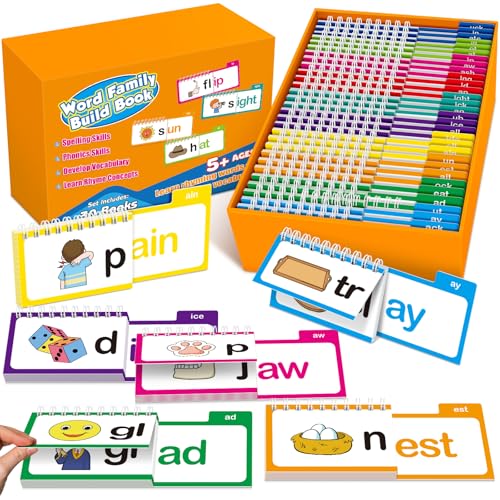
Edulok’s 30-word-family flip books provide a hands-on approach to learning word families, with vivid illustrations that reinforce pattern recognition. Each flip book doubles as a set of word-family flash cards, supporting systematic practice in blending, rhyming, and decoding. The interactive flip design encourages kinesthetic learners to manipulate letters and roots to construct new words, while the included pictures aid memory and comprehension. This kit is well-suited for small-group activities, homeschool labs, and classroom centers focused on early literacy foundations.
Buying Guide
Key purchase considerations help determine which phonics flash card set best fits your goals and learning context. Consider the following perspectives:
- Learning goals: If the aim is foundational decoding, prioritize sets with CVC, blends, and digraphs. For fluency and sight word recognition, choose kits with high-frequency words and sentence practice.
- Structure and progression: Look for programs that offer a clear, multi-level sequence. Four-level or multi-stage sets support ongoing growth from kindergarten through early elementary grades.
- Interactive features: Rings, flip books, and vibrant visuals can boost engagement for reluctant learners. Decide whether hands-on manipulatives align with your teaching style.
- Classroom fit: Consider deck size, portability, and whether the set includes teacher guides or parent resources. Online components can supplement offline practice for blended learning.
- Assessment support: Some kits include progress tracking features or reference cards for teachers and parents to monitor mastery of phonics concepts.
- Durability and age range: Choose sturdy cards suitable for daily use and appropriate for the child’s age and reading level.
- Accessibility: For mixed-ability classrooms or diverse learners, ensure the materials offer clear visuals, large print, and simple instructions.
Different families and classrooms benefit from different mixes of phonics content. Some teachers prefer a primary emphasis on blending and decoding, while others integrate word families and sight words for a well-rounded early literacy routine. When evaluating options, consider how the cards will be used—daily quick reviews, guided lessons, or independent centers—and whether the product supports your agreed curriculum goals. The right combination can help build confidence, fluency, and a lifelong reading habit.