Exploring the night sky with a reflector telescope is a popular entry point for beginner astronomers. This guide highlights five easy-to-use reflector models, emphasizing simple setup, stable mounts, and clear optics. Each option provides solid performance for learning the constellations, the Moon’s craters, and bright deep-sky objects.
The following table offers a quick snapshot of the selected products to help you compare at a glance before diving into detailed sections.
| Product | Brand | Aperture | Mount Type | |
|---|---|---|---|---|
| Celestron StarSense Explorer LT 114AZ | Celestron | 114 mm | Altazimuth with Smartphone Dock | StarSense technology, smartphone app navigation, beginner-friendly |
| MEEZAA 150EQ | MEEZAA | 150 mm | German Equatorial Mount | High light gathering, 26x–130x, moon filter, steady tracking |
| Celestron PowerSeeker 127EQ | Celestron | 127 mm | German Equatorial Mount | Compact, versatile, reliable entry-level options |
| HEXEUM 80mm | HEXEUM | 80 mm | AZ Mount | Lightweight, portable, simple setup, phone adapter |
| YENGUAN 150EQ | YENGUAN | 150 mm | Equatorial Mount | High magnification options, sturdy EQ mount, included accessories |
Celestron StarSense Explorer LT 114AZ: App-Assisted Beginner
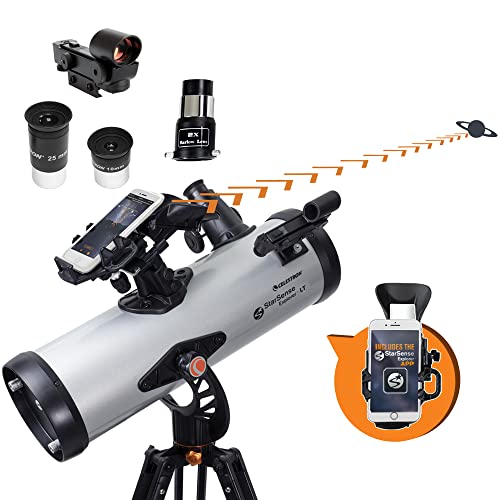
The StarSense Explorer LT 114AZ combines a 114 mm reflector with a user-friendly smartphone docking system. The StarSense app analyzes star patterns to guide the user toward celestial targets, reducing time spent locating objects. This makes it an attractive option for beginners who want quick, visual access to planets, nebulae, and star clusters. The app generates a tailored list of objects based on time and location, improving early-night success rates for new observers.
MEEZAA 150EQ: Bright Views With Easy Tracking
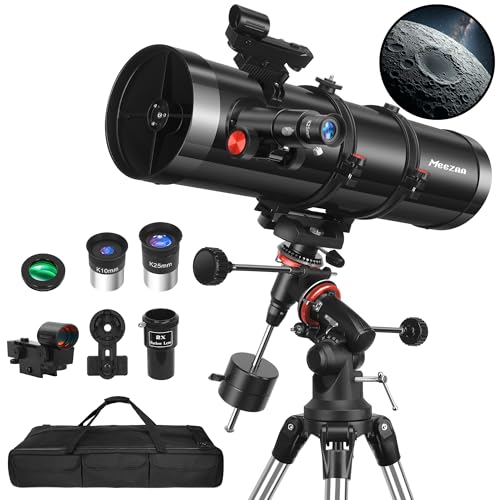
The MEEZAA 150EQ offers a 150 mm aperture and a sturdy German Equatorial Mount for precise object tracking. With a 650 mm focal length, this telescope delivers strong light gathering for deep-sky objects and detailed lunar views. Included eyepieces (25 mm and 10 mm) plus a 2x Barlow lens provide 26x–130x magnification. A red-dot finder helps with quick targeting, and a moon filter reduces glare for comfortable lunar observing, making it a strong option for beginners seeking expanding capabilities.
Celestron PowerSeeker 127EQ: Balanced Entry-Level Choice

The PowerSeeker 127EQ emphasizes a practical, portable design with a 127 mm aperture and a German Equatorial Mount for smooth tracking. This combination supports reliable viewing of the Moon’s craters, bright planets, and nearby deep-sky objects. The manual control encourages new users to learn sky navigation with slow-motion adjustments, making it suitable for families and classrooms seeking a durable, affordable starter telescope.
HEXEUM 80mm: Lightweight Starter Model

The HEXEUM 80mm telescope focuses on portability and ease of use. With an 80 mm aperture and 600 mm focal length, it provides bright, clear views for beginners. The included phone adapter and a lightweight tripod support quick setup, and the wireless control adds modern convenience. This model is well-suited for casual stargazing and daytime terrestrial viewing as well, offering a versatile entry into astronomy.
YENGUAN 150EQ: High-Powered Beginner’s Kit

The YENGUAN 150EQ combines a large 150 mm aperture with an Equatorial Mount for precise tracking and wide viewing potential. It offers up to 160x magnification, depending on eyepieces, and includes a phone adapter and carrying bag for portability. The preassembled setup and slow-motion controls simplify alignment for beginners, while the stronger light-gathering capability supports deeper sky exploration as skills grow.
Buying Guide: Key Purchase Considerations
Purpose and skill level: Beginners typically benefit from reflector models with moderate apertures (80–150 mm), straightforward assembly, and stable mounts. Look for features that reduce the learning curve, such as easy object locating, built-in guides, or user-friendly aiming aids.
Mount and stability: German Equatorial Mounts offer precise tracking but can be slower to set up. Altazimuth mounts are simpler but may be less stable at higher magnifications. Consider your preferred balance of ease versus tracking accuracy for long-term growth.
Optics and accessories: Fully coated optics improve brightness and contrast. A range of eyepieces (e.g., 25 mm and 10 mm) plus a Barlow lens expands magnification options. A Moon filter can improve lunar viewing, and a finder scope aids object location.
Ease of use and upgrades: App-assisted models and smartphone docking can dramatically shorten the learning curve for first-timers. If you expect to upgrade later, choose a telescope that allows growing with additional eyepieces or compatible accessories.
Portability and storage: If space is limited or you plan to travel to dark-sky sites, lighter frames and compact tripods are advantageous. Carrying bags and travel-friendly tripods help with transport and organization.
Durability and support: Established brands often provide better after-sales support and available replacement parts. Look for customer reviews that mention build quality, ease of use, and telescope calibration over time.
Educational value: Some models align with beginner astronomy education—star-hopping basics, sky charts, and simple celestial object lists. If learning with family or students, a model with clear instructional resources can be a wise choice.