Model car builders deserve a 3D printer that blends high-detail output with reliable performance and manageable setup. The following selection focuses on printers that deliver sharp edges, smooth surfaces, and consistent first layers, whether you’re spinning up tiny chassis parts or detailed scale replicas. From fast CoreXY systems to high-resolution resin machines, these models offer strong value for hobbyists and enthusiasts pursuing realistic car models.
| Product | Type | Best For | Notes |
|---|---|---|---|
| FLASHFORGE Adventurer 5M | FDM | Rapid prototyping, mass modeling | Auto leveling, high-speed, fast warm-up |
| FLASHFORGE Adventurer 5M Pro | FDM | Detail with speed | Pressure sensing auto-level, multi-nozzle options |
| Creality K2 SE | FDM | Solid build, stable high-speed | Auto leveling, multi-color-ready via CFS |
| Creality Ender 3 V3 SE | FDM | Value with speed | Sprite direct extruder, CR Touch leveling |
| ANYCUBIC Photon Mono 4 | Resin | High-detail miniature parts | 10K LCD, LighTurbo light source |
FLASHFORGE Adventurer 5M: Fast Auto-Leveling FDM Printing

The Adventurer 5M brings automated bed leveling and high-speed CoreXY motion for quick, precise model car components. Its 600 mm/s travel speed and 20,000 mm/s² acceleration help you iterate wheel hubs, chassis brackets, and accurate scale parts with less manual effort. A fast nozzle change system and a dual-sided PEI bed support easy part removal and reliable first layers, reducing post-processing time for complex car assemblies.
FLASHFORGE Adventurer 5M Pro: Auto-Printing Efficiency

The Adventurer 5M Pro emphasizes creative flow with automatic bed leveling, a 600 mm/s top travel speed, and quick heating to 200°C in about 35 seconds. Its multiple nozzle sizes enable balancing speed and detail for scale engine blocks, body panels, and intricate accessories. The all-metal Core XY frame provides stability during rapid movements, which helps maintain dimensional accuracy on larger, detailed car models.
Creality K2 SE: High-Speed, Multi-Color Readiness
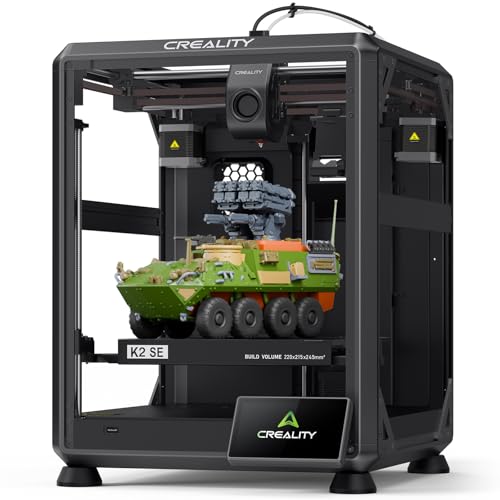
Ideal for model car builders who want speed without sacrificing stability, the K2 SE delivers 500 mm/s printing through a lightweight CoreXY system and an aluminum frame. Auto leveling with robust stability reduces layer skew during high-speed passes, while compatibility with multi-color setups via Creality CFS expands your color options for detailed car shells and logos. The direct-drive option supports flexible filaments, widening material choices for scale models.
Creality Ender 3 V3 SE: Speedy, Reliable Upgrade

Ender 3 V3 SE offers a notable speed bump to 250 mm/s with improved acceleration and the Sprite direct extruder for better filament control. Auto-leveling with a CR Touch ensures consistent first layers on varied bed surfaces, reducing trial-and-error for scale chassis and parts. Durable components and a strong community provide solid long-term support for hobbyists building model cars with multiple materials like PLA and PETG.
ANYCUBIC Photon Mono 4: Resin Detail for Fine Car Models

The Photon Mono 4 brings high-resolution resin printing with a 7-inch 10K Mono LCD for ultra-fine details—ideal for tiny car components like grilles, emblems, and engine detailing. The LighTurbo light source ensures uniform exposure for smooth surfaces, while the compact build volume supports detailed miniature parts. Resin printing excels where surface finish and precision matter most, though post-curing is typically required.
Placeholder Link
Buying Guide: Key Factors To Consider
When choosing a printer for model cars, consider the printing technology (FDM vs resin), expected detail level, and build volume. Resin printers like the Photon Mono 4 deliver sharp edges and fine textures essential for scale detailing, but require harsher post-processing and ventilation. FDM printers offer larger build areas, faster iteration times for larger parts, and easier cleanup but may need more part-filling or sanding to achieve smooth surfaces.
Auto leveling and bed adhesion are valuable for consistent first layers, especially on small car components. Look for a stable frame (CoreXY or rigid dual-extrusion setups) to minimize vibrations during high-speed printing. Nozzle options and fast warm-up times help with rapid prototyping, but remember that nozzle wear varies with material. Multicolor capabilities, when needed, can simplify color-mke parts without post-painting.
Materials compatibility matters. PLA and PETG are beginner-friendly, while ABS or nylon require enclosure and ventilation considerations. If you plan multicolor or multi-material builds, ensure the printer supports the desired workflow, whether through multi-nozzle configurations or color-changing systems (CFS). Finally, assess support, community resources, and available upgrade paths to grow with your model-car projects.
For beginners, a printer with automatic bed leveling, user-friendly interfaces, and reliable first-layer performance reduces trial-and-error time. Intermediate users may prioritize speed and multi-material capability, while advanced hobbyists often value resin detail or dual-extrusion options for complex parts and custom badges.
Bottom line: choose based on the size of your scale models, the level of surface finish you require, and how much post-processing you’re willing to perform. Resin printers excel in detail for small parts; FDM printers offer volume and versatility for larger components and assemblies.